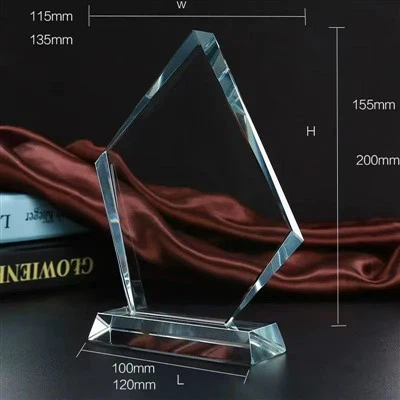
Hey there! As a supplier of crystal blocks, I often get asked about what these shiny beauties are made of. So, let's dive right into the chemical composition of crystal blocks.
First off, it's important to understand that not all crystal blocks are the same. There are different types, each with its own unique chemical makeup.
Common Types of Crystal Blocks and Their Chemical Compositions
1. Solid Crystal Block
The Solid Crystal Block is one of the most popular types. Most solid crystal blocks are made primarily of silicon dioxide (SiO₂). Silicon dioxide is a compound that you can find in nature as quartz. It's what gives the crystal block its clarity and hardness.
In addition to silicon dioxide, solid crystal blocks may also contain small amounts of other elements. These impurities can actually affect the color and properties of the crystal. For example, iron impurities can give the crystal a yellow or brown tint. Aluminum might be present in trace amounts, and it can influence the crystal's refractive index, which is how light bends as it passes through the crystal.
The manufacturing process of solid crystal blocks involves melting high - purity silicon dioxide at extremely high temperatures. Then, it's carefully cooled and shaped into the desired block form. This process ensures that the crystal has a uniform structure and high optical quality.
2. Crystal Glass Brick
Crystal Glass Brick is another type that we offer. Unlike pure crystal, crystal glass bricks are a bit different in their chemical composition. They are made from a mixture of silica (SiO₂), soda ash (sodium carbonate, Na₂CO₃), and lime (calcium oxide, CaO).
The soda ash is added to lower the melting point of the silica, making it easier to work with during the manufacturing process. Lime is then added to make the glass more durable and resistant to water.
Just like solid crystal blocks, crystal glass bricks can also have impurities. These impurities can come from the raw materials used or from the manufacturing process itself. For example, if there are small amounts of lead in the glass, it can increase the refractive index, giving the glass a more brilliant sparkle.
3. K9 Crystal Block
The K9 Crystal Block is a high - quality crystal block. K9 crystal is a type of optical glass. Its main component is also silicon dioxide, but it has a higher purity compared to regular glass.
K9 crystal typically contains about 68% - 72% silicon dioxide. In addition to silicon dioxide, it also contains boric oxide (B₂O₃), which helps to improve the chemical stability and thermal resistance of the crystal. Other elements like potassium oxide (K₂O) and sodium oxide (Na₂O) are also present in small amounts to adjust the melting point and other physical properties.
The high purity of K9 crystal gives it excellent optical properties, such as high transparency and a high refractive index. This makes it ideal for applications where optical clarity is crucial, like in precision optical instruments.
How Chemical Composition Affects Properties
The chemical composition of crystal blocks has a huge impact on their properties. For example, the hardness of a crystal block is related to the strength of the chemical bonds in its structure. Silicon dioxide has strong covalent bonds, which is why solid crystal blocks and K9 crystal blocks are relatively hard.
The color of the crystal is also determined by its chemical composition. As I mentioned earlier, impurities can introduce color to the crystal. For instance, if there are copper impurities in a crystal block, it might have a blue or green tint.
The refractive index, which is important for how the crystal looks and how it interacts with light, is also affected by the chemical composition. Crystals with a higher refractive index will bend light more, creating a more brilliant and sparkly appearance. This is why K9 crystal, with its carefully balanced chemical composition, is so popular for decorative and optical applications.


Why It Matters for You as a Buyer
Understanding the chemical composition of crystal blocks is important for you as a buyer. If you're looking for a crystal block for a decorative purpose, you might want one with a high refractive index to create a dazzling effect. In this case, a K9 crystal block could be a great choice.
If you need a crystal block for a more practical application, like in a laboratory or an industrial setting, you'll want to consider its chemical stability and hardness. Solid crystal blocks, with their high - purity silicon dioxide, are often a good option for these types of applications.
If you're on a budget or need a larger quantity, crystal glass bricks can be a cost - effective alternative. They still offer a good level of clarity and sparkle, and their chemical composition makes them relatively easy to manufacture in large sizes.
Get in Touch for Your Crystal Block Needs
So, now that you know all about the chemical composition of crystal blocks, are you ready to make a purchase? Whether you're interested in Solid Crystal Block, Crystal Glass Brick, or K9 Crystal Block, we've got you covered.
We offer a wide range of crystal blocks in different sizes, shapes, and qualities. Our team is always here to answer your questions and help you find the perfect crystal block for your needs. Don't hesitate to reach out and start a conversation about your crystal block requirements. We're looking forward to working with you!
References
- "The Chemistry of Glass and Crystals" - A textbook on the chemical properties of glass and crystal materials.
- "Optical Properties of Crystals" - Research paper on how chemical composition affects the optical properties of crystals.