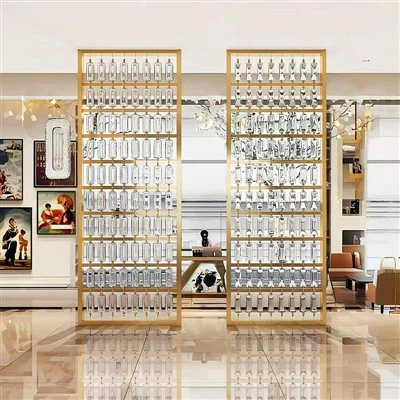
Solid crystal blocks are a fascinating and versatile product that has found numerous applications in various industries, from interior design to high - tech manufacturing. As a supplier of solid crystal blocks, I often get asked an interesting question: Do solid crystal blocks conduct electricity? In this blog post, I'll delve into the science behind crystal conductivity, explore different types of solid crystal blocks, and discuss their electrical properties.
Understanding the Basics of Electrical Conductivity
Before we can determine whether solid crystal blocks conduct electricity, it's essential to understand what electrical conductivity is. Electrical conductivity is the measure of a material's ability to allow the flow of electric current. This flow is facilitated by the movement of charged particles, typically electrons. In metals, for example, there are free electrons that can move easily through the lattice structure, making metals excellent conductors of electricity.
On the other hand, insulators have very few free electrons, and their electrons are tightly bound to the atoms. As a result, they do not allow the easy flow of electric current. The conductivity of a material is usually measured in siemens per meter (S/m).
Types of Solid Crystal Blocks and Their Conductivity
There are different types of solid crystal blocks, each with its own unique properties. Let's take a look at some common types and their electrical conductivity.
K9 Crystal Block
K9 Crystal Block is a popular type of crystal block known for its high clarity and refractive index. K9 crystal is a lead - free optical glass, and like most glasses, it is an insulator. Glass has a very low number of free electrons, and its atomic structure does not allow for the easy movement of charge carriers. Therefore, K9 crystal blocks do not conduct electricity under normal conditions.
The structure of K9 crystal consists of a network of silicon and oxygen atoms, with other elements added to modify its properties. These atoms are held together by strong covalent bonds, which keep the electrons tightly bound. As a result, when an electric potential is applied, there is no significant flow of electrons, and the crystal block acts as an electrical insulator.


Frosted Glass Brick
Frosted Glass Brick is another type of solid crystal - like block. Frosted glass is made by treating regular glass to create a rough surface that diffuses light. Just like regular glass, frosted glass is an insulator. The process of frosting does not change the fundamental electrical properties of the glass.
The glass matrix in frosted glass bricks is composed of a non - conductive material. The frosting is mainly a surface treatment that affects the optical properties of the glass, such as light diffusion, but has no impact on its electrical conductivity. So, frosted glass bricks are also poor conductors of electricity.
Office Crystal Brick Partition Wall
Office Crystal Brick Partition Wall often uses crystal blocks to create a modern and aesthetically pleasing workspace. These crystal blocks are typically made of glass or other non - conductive materials.
The purpose of these partition walls is mainly for visual separation and design. Since the materials used are insulators, they do not conduct electricity. This is an important safety feature, especially in an office environment where there are electrical appliances and wiring.
Exceptions and Special Cases
While most solid crystal blocks are insulators, there are some exceptions. Some crystals, such as certain semiconductors, can conduct electricity under specific conditions. Semiconductor crystals, like silicon and germanium, have a conductivity that lies between that of conductors and insulators.
These semiconductor crystals can be doped with impurities to increase their conductivity. Doping involves adding small amounts of other elements to the crystal lattice, which creates either extra electrons (n - type doping) or holes (p - type doping). When a voltage is applied, these charge carriers can move through the crystal, allowing for the flow of electric current.
However, the solid crystal blocks that we supply as a company are mainly non - semiconductor materials, such as glass - based crystals. So, in general, our solid crystal blocks do not conduct electricity.
Applications of Non - Conductive Solid Crystal Blocks
The non - conductive nature of solid crystal blocks makes them suitable for a wide range of applications.
Interior Design
In interior design, solid crystal blocks are used to create partitions, decorative elements, and lighting fixtures. Their non - conductivity ensures that they can be safely used in areas with electrical systems. For example, Office Crystal Brick Partition Wall can be installed in offices without the risk of electrical short - circuits.
Art and Sculpture
Artists often use solid crystal blocks to create sculptures and art pieces. The non - conductive property of the crystal allows for greater creativity in design, as it can be combined with other materials and electrical components without the risk of electrical interference.
Optics
Solid crystal blocks, especially those with high optical quality like K9 crystal, are used in optical applications. Their non - conductivity is an advantage in these applications, as it does not interfere with the optical properties of the crystal.
Conclusion
In conclusion, most solid crystal blocks, such as K9 crystal blocks, frosted glass bricks, and those used in office crystal brick partition walls, do not conduct electricity. They are insulators due to their atomic structure and the lack of free electrons. However, there are some semiconductor crystals that can conduct electricity under specific conditions.
As a supplier of solid crystal blocks, we offer a wide range of products that are not only aesthetically pleasing but also safe to use in various environments. If you are interested in purchasing solid crystal blocks for your project, whether it's for interior design, art, or optics, we would be more than happy to discuss your requirements. Contact us to start a procurement discussion and find the perfect solid crystal blocks for your needs.
References
- "Introduction to Solid State Physics" by Charles Kittel
- "Optical Properties of Glass" by H. Bach and N. Neuroth